Showing posts with label language. Show all posts

Friday, October 17, 2014

Hypocorisma

As an avid reader of Daily Writing Tips, I just discovered that when I named my small dog 'Doggy Dog' that I committed a hypocorisma, which is a diminutive and a pet name. It can also be a diminutive name or an altered name. I didn't call her 'bow-wow' though. Altering a name, or just addressing some one as 'dear' can be rather condescending if one doesn't really know the person. Small children and elders are often addressed with hypocorisma... which can be insulting or infantilising... depending on the situation. So normal speech is more respectful, it avoids the dumbing down of the person spoken to.

Monday, August 18, 2014

Lucienne Stassaert and the translation of Emily Dickinsons poetry

Yesterday Lucienne Stassaert dropped in and after her visit I revisited some of her translations of Emily Dickinson. It is incredibly hard to translate Emily Dickinson's work since mostly she writes sparsely, just a few words - dashes - and deep thought. The difficulty in translating Dickinson's work is that the words she uses do double and often even triple duty. incorporating the resulting layers of meaning is sheer impossible. I admire Lucienne's reckless poetry and I see some of the traits of her own poetry showing up in her translations. Her double word formations really work as an enrichment of the language of her Dutch translation. Moreover Lucienne has created a free space of creativity and freedom yet still remains true to the great original texts.

Wednesday, July 2, 2014

VERS 1984-2014


A friend and colleague Karel Sergen launched this fun and serious project. Bar Van Loo had sugested to find one's own audience for an original selection of thirty years of poetry. So Karel mailed out an extended overview of his work and asked his friends poets to choose one poem and write a short commentary like one would send a tweet. The publisher P Leo Peeraer of 'Uitgevery P' accepted the challenge to publish this book, and unbeknown to all the poets who send in their favorite poem they were considered co-authors of the book and received it as a gift. The celebration of this project was the reason we drove with four people from Antwerp to Saint Remy-Geest, the beautiful village just over the language border. I was again impressed by the place. I was even more impressed by the careful preparation of the program for the day. Karel is form the Dutch peaking part of Belgium and lives in the French speaking part since quite a while. I was impressed that the local dignitaries were bilingual. The authors speaking and reading were bilingual too and so is the book. Bernard De Coen, in close collaboration with Karel made a great and wonderful translation into French.

Everything breathes beauty and caring and even a deluge couldn't stop the festivities. In three different spots the poets who had chosen their 'favorite' read it for the audience. Everybody had a great time. I felt hopeful because of the inclusiveness of the whole day. On the picture right you see Karel (left) and Bart (right). French and Dutch, Japanese and English, all together. Hilde Keteleer is reading and I must thank her for letting me use her pictures. I love the attention to detail, the edible flowers, the great people there and the beautiful together of poetry and language.Even old chairs became poetic objects with a haiku.

    Wednesday, March 13, 2013

    Sequenza - Marleen de Crée

    Marleen de Crée needs no introduction in Belgium. She is one of our well known poets and has quite an oeuvre to her name. Next Friday, March 15, in den Hopsack in Antwerp her bilingual book Sequenza will be presented. It will be an interesting and varied evening. Expect video poems, reading in two languages: the Dutch original and the English translation. There will be music. The title of this book of poetry refers to composer Luciano Berio and for those who don't know technically what a Sequenza is, Vlad Weverbergh will perform that evening Sequenza IXa on the clarinet. Frank De Vos will be the troubadour with two songs and will read one poem in Dutch. Intro by Annmarie Sauer.

    The presentation starts at 8.30 in Den Hopsack is in the old part of town: Grote Pieter Pot straat 24, Antwerp 2000.
    It will be a worthwhile, even a memorable evening.

    Sequenza ISBN 9783842341449
    world internet books


    Sunday, December 16, 2012

    Friday night in Brussels

    Rain, wind and darkness, dangerous driving by tired lorries swerving out of their lane and the expected standstill on the roads into Brussels. One of the tunnels into town was closed off because of a European Summit meeting. Yet following the signs for the detours, I ended up in the tunnel and got well in time to the salons of the Liaison Office Brussels-European Union where the reading was to be held. The languages used that evening where: French, English, Portuguese, Italian, Spanish - in the Chilean variety which I love, Dutch, German, Alsatian, Romanian and Greek (both old and new). It was lovely to listen to the former or still active ‘Eurocrats’ who all defended their creative irk against or not withstanding hard work and a no-nonsense atmosphere when at work. The poems were always read first in its original language and then in a translation. Some people also sculpt or paint, or do graphics, make  music. The singer, Hugo Bossut, we were sorry to hear, was ill, some people, seen the chaos on the road didn’t make it. Yet there was a good group of excellent listeners. I had been involved with the Literary circle over 20 years ago and then lapsed. Finding in a publication a poem by Huguette Bastin, who was my contact then, I decided to contact her. Thus I ended  up as the mystery guest at the end of an evening. Huguette did a wonderful job introducing her colleagues, keeping time gently. The way she presented and interviewed me was delightful. She read the Dutch versions of my poems and I read them in my variety of Mid-Atlantic English: too European for Chloride, Arizona, too American for sensitive British ears. People were generous with kind comments and some even bought Traces/Sporen, published by world-internet-books.com. So it turned out to be a happy evening with light refreshments afterwards and conversations with interesting people.
    My colleagues that evening were: Danial Guggenbühl, Catherine Koecks and Archie Clarke, Frederique Frahan-Dupont and Bruno Delmotte, Joqé Ponce Vicencio, Andrei-Paul Corescu, Paolo Pego, Fontini, Chiou, Isabelle Bielecki and Huguette Bastin. The second name always is the one having done or reading the translations.

    Saturday, October 27, 2012

    Two poet friends -

    Recently two friends of mine who write poetry had a presentation of their latest book. One in The Black Panter by Marleen De Crée: Tussen boog en snaar (Between bow and string) a grandiose overview of her work and the other one in the Hoboken town hall Frank De Vos: Naamvallen in het ontheemde. In order to translate the latter title well, I'll have to do some more thinking. Naamvallen are conjugations of nouns and literally it is "Namedropping". That is the first problem, the second is in het ontheemde: normally it is 'de' ontheemde: the homeless, the rootless, the uprooted, a displaced person also a drifter yet 'het' ontheemde is not a stupid grammatical mistake, but a beautiful metaphor for the strangeness of the world in which we live. Both poets have great musical knowledge and taste. So for Marleen we heard Floris De Rycker playing the Thiorbe (imagine a very long necked lute) and Frank surprised us with Bach and others on the accordion, the poor mans organ. Both musical delicacies I had never tasted. Marleen deserves this second volume of the Parnassus series for her assiduous unwavering writing, unimpressed as she is by fads or fashions: You find really modern sonnets, other strict forms and when you read they flow, are natural and they will grab you. Yes I love her work and beginning of January a bilingual book will come out called 'Sequenza', as in the way Berio did some of his compositions. She chose 5 poems from 7 volumes of poetry when she turned 70, a good overview for English speaking readers.
    Frank's work has a mesmerizing rhythm, almost like a litany in church with in the first cycle a repetition of the words: I, we, us: the solitary poet striving for, finding 'the other' in his writing. I am very impressed by his anti war poetry. If you can read Dutch, just get both books.

    Monday, September 3, 2012

    Living on the edge of the Jewish quarter

    Living on the inner edge of the Jewish quarter I have a choice when  I go shopping: to the right or straight ahead I'll see the people in their diverse religious attire. Fedora like hats on top of the head, white shirt all in black with the curls along the ears flying while cycling on the boardwalk. Yarmulke's and the fringe of their ceremonial scarfs peeping out from under the coat, while some where long white stockings and large fur hats, which when it rains are covered in a specially designed plastic bag. The women I saw this morning wore all a different color of wig: black or blond, light or dark brown. All wore comfortable flat shoes. The difference between richer and poorer Jews is immediately visible. The poorer women can't afford a good wig, so they wear scarves, either hiding all their hair or a scarf with an attached fringe of hair sticking out.
    Since there are also a lot of Polish Jews there are also some good polish shops where you find kefir, other wise only found in the health shop or in the Pakistan shop. I also notice that some peope go to synagogue each morning and on special occasions they'll have palm leaves wrapped in plastic under their arm.
    Going left however, I enter the general mainly European stream of peoples, with North Africans and black Africans being part of the mix just as Turkish and oriental people. A friend once called me on the fact that when one is at a local police station and does not speak the local language that one has to bring an interpreter. She was totally offended by this and thought the city should have the interpreters on call. So I got curious and asked how many languages were present in the small old jail, where people who have been picked up wait for their first meeting with the judge. The answer was a to me staggering amount of 76 languages. So the menu is from kosher to halal, from bio dynamic to straightforward meat, potatoes and veggies... All in walking distance. Wonderful.
    What I don't understand is that the protests against the scarfs Muslim women wear and the acceptance of the same principle in a different execution in the Jewish community. In both cases the hair of women is supposed to for private viewing only.

    Tuesday, July 17, 2012

    Proofreading Sequenza

    The stages for me in a translation process of poetry are manifold: reading the text through, talking to the poet, do a first translation, noting alternatives, problems unsolved at that moment and sending the text to the poet if s/he knows the target language. Then think to through the remarks of the poet and making a clean copy with just very few options still open. It is always about the right word, rhythm and meaning. Then we read through the text together, discuss the merits of each choice and reach a conclusion together. It is obvious that the end result should be a poem, mirroring the original in its new cloak, in the other language.

    After the work is  done there are cookies and coffee and chatting and walking through the marvelous garden of the poet...

    The first  poems I read written by Marleen De Crée was  the book 'Brieven aan Plinius' from which an example follows:


    ik zeg je, Plinius, het is september.
    de dichters keren in ’t getij.
    vruchten rijpen aan de warme muren,
    vergeet dat niet: het zijn de laatste uren

    van de zomer. warmte, niets kan nog gebeuren.
    het zijn de stille dagen van het jaar,
    want alles wordt geduldiger gedragen
    in veelvoud van de laatste dracht.

    september weet wat dierbaarheid betekent
    en liefde tekent schaduwen van was.
    ik zeg: voorzichtigheid werd ooit berekend

    aan de contouren van een waterglas.
    de druiven, Plinius, de laatste schragen
    van wat een dichterzomer was.

    ***
    I tell you, Plinius, it is September
    poets turn in the tide.
    fruit ripens on warm walls,
    don’t forget: these are the last hours

    of summer. warmth, nothing can happen still.
    it are the quiet days of the year,
    because more patiently all is carried
    in multiples of the last gestation.

    September knows what fondness means
    and love draws shadows of wax.
    I say: once prudence was calculated  

    by the outline of a water glass.
    the grapes, Plinius, the last trestles
    of what a poet’s summer was.

    This is the first poem in the upcoming bilingual book 'sequenza', published by world internet books

    Wednesday, May 23, 2012

    Vulcan greetings..

    Here Mark giving the vulcan salute... It is a hello and a good bye blessing.
    So here I leave the USA for a while and dive back into the other languages of my life. This man has invented, constructed three different languages for far away planets.

    I just reinvent poetry in an other language. So if ever you come acros an alien and have communication troubles, call Mark!

    And yes: prosper and live long!

    Sunday, April 29, 2012

    desert poetry night


    at Annmarie’s old gas station in Chloride, Monday April 30th, 6 pm

    Two poets, Fred Schywek from Germany and American born Annmarie Sauer, also translate poetry and produce multi-lingual books. Thus European authors can be read in the USA and American poets in Europe.

    In the framework of April National Poetry Month, supported by the Academy of American Poets, they decide to organize a desert poetry night in Chloride, Arizona, at Annmarie’s Old Gas Station.

    The experimental global night car will be premiered in the USA: it is a collaborative poem by nine poets from different countries and continents. Yet there also is cowboy poetry and work from locals like Jandolin Marks from Dolan Springs will be heard. Also Cooper Gallegos, California, will read from her latest book. Singer/songwriter and local country star Al Brock will perform in the Johnny Cash tribute for his 80 birthday this year. Donna Meyer will offer Chloride limericks. We strive for diversity and openness. Cowboy poetry by Judd Bishop will be read by his son Dan Bishop and Jean Bishop will read from her mother in law’s work, Jennielee Bishop. There is also an open mike.

    Fred Schywek will read from Felsenleiter/Rockstairs and from Weiße Mühle/White Mill with a translation in English as a preview for the books to be published in early autumn.

    Annmarie Sauer will read from Traces/Sporen in which you’ll find several Cerbat and Chloride landscape inspired poems. Dori Vaughn will perform/interpret three poems of her choice from Traces/Sporen in American Sign Language.

    You can follow the developments concerning these readings on:

    Friday, March 30, 2012

    Bart Stouten's Open Heart presented in den Hopsack

     When the producers of the books are part of the presentation then only the preliminary activities can be documented.
    Here Fred Schywek carrying in the books...
     A bit of publicity in the window doesn't hurt.
     And hanging the banner of the traveling Poetry Festival this evening is also part of the producer's job.
     Here poet Bart helps carry in the music stand for his friend Jan Evenepoel
     Sound man Erwin at work and the star of the night checking out the finished book he his holding for the first time. He seems  to be smiling like the cat who ate the canary, also his partner Mark seems to enjoy the special night.
     A wonderful guitar player, a choice of music that was just right for the mood of the night and and the audience. I realized how I missed  hearing the soft twang or thud of the gentle touch of a string. Thanks!
     Poet and musician concentrating, going inward... to come out and be totally present when it matters. The program:
    1.  INTRODUCTION - Frank DE VOS
     MUZIEK 1: Jan EVENEPOEL
     2.  POETRY READING 1
    OPEN HEARTH OF LANGUAGE - Bart - GENTSE BEGRAFENIS MET FLASHBACK - Bart & Annmarie - POETRY IS… Bart & Fred  - HIMEJI 2004 Annmarie -
    MUSIC 2 - JAN EVENEPOEL
    3. POETRY READING 2: ATHENS 6 AM - Fred - Bart - HAMA Bart & Annmarie - GEEN VOLLE MANEN MEER (no more full moons) Bart & Fred
    MUSIC 3 - Jan EVENEPOEL - Frank DE VOS closes – SUIKERBONEN (Belgian sweets offered when a baby is born -)) Thanks too for a loyal, attentive audience and friends

    Now we're on the road again... from E 19 to Route 66...

    Thursday, March 29, 2012

    Muddy roads will be traveling soon but first Bart Stouten's presentation tonight


                        Flying.
    A feeling of laying in an unmade bed.
    Staring at Buddhist sutras
    from floor to ceiling
    slipping in and out one's consciousness.
    Feeling the sutras
    keep you alive.
                        The stewardess, a cameo appearance
    in dark Chinese whispers, brought coffee,
    lukewarm and annoyingly weak with powdered milk
    and a glimpse of hauling about her darlings.
    Made corny jokes about thick and thin. Her own choice
    written on her body. In fluent French.
    No idea where it came from. That feeling.
    I loved her, briefly, put myself to work
    emptied all this thinness.
                        Waiting, with sleep and in-flight magazine,
    for better pastimes.
                        It came. High above the gold coast,
    which reminded my neighbor of the complicated timing
    of coming into the world elsewhere: mom's returning
    from a trip to Papua New Guinea, her desire
    to birth him in Australia, his first scream
    in a Lockheed Hercules en route. And how he
    two years ago – his pousse café a fait divers
    for Quantas – was gripped by a fear of flying so intense
    that he nailed to the floor, watched how the plane left
    without him, to yet another continent.
                        ...in an unmade bed... staring at
    Buddhist sutras...
                        For me no alcohol.
    Vascular problem requiring an understanding smile,
    so thinks the stewardess.
    *
    8 pm: in den Hopsack, Grote Pieter Pot straat, Antwerp, Belgium

    Monday, March 26, 2012

    Preparations for a poetry presentation

     After translating, proofreading with the authors and the lay out follows the printing and shipping of the books. Since we presented work of three poets we made little bundles of the three books with colorful, joyous ribbons.
     And yes, poetry for the world for books arriving on Unesco's world poetry day on March 21.
    Then the producer/ translator/ poet, founder of world internet books Fred Schywek carries the result of months and months of work to the Gallery De Zwarte Panter. Here Annie Reniers is doing a sound checkwhile host Adriaan checks lights, helps with putting up chairs, provides a table for the books and even came up with a blue money box. The last words of her book Buchstabenlicht - Letters van licht- Letters of light is the title of her book.


    the step out of time
    brings us back

    to the immediacy
    of resistance and resurrection

    a form appears
    of branches of air
    magnanimous in meeting

    and silence
    silence cuts a road

    rivers flow out of an Eden 
    fires rage through centuries
    for an egg of warmth

    sketch
    drawn after no one’s image

    unadulterated
    in letters of light

    Saturday, March 24, 2012

    Presentation of Light traces in De zwarte panter: Three books of Poetry

     Three poets who have known each other for a long time decided to present the heir new books together in The black Panter Gallery. It is a magical 15th century chapel where art in all its forms is celebrated. The host is Adriaan Raemdonck, ambassador of cultural life in Antwerp.
    Fred reading the German translation of Annie Yet the road to a presentation is a long one. First of all the producer of the books Fred Schywek, poet and responsible for the translation from Dutch into German and Annmarie Sauer, poet and responsible for the translations into English have to feel comfortable in working hand in hand with the poets.The translations are proofread together with the authors and deep discussions arise. 


    In Annie Reniers' Buchstabenlicht - Letters van licht - Letters of light it might have been about the philosophical connotation of a word or nod to one or other art theory. With Roger Nupie's Lighthouse - Lichthaus it was about choices in the level of 'naughtiness' and comma's. Traces - Sporen is a bilingual book translated by the author herself.
     One will note that in the translation of the works of others she is loyal, yet in the translations of her own work she makes choices that can lead to quiet a difference between the two languages. Then the lay out, the page numbers... The producers job.
    Then a concept is worked out for the presentation and yes, it worked. The audience was warm and listened intently, we had help from friends Unciya and Hakate to man the book stand. friends worked the bar, brought the drinks and Bram Goots and Maya filmed the event. Thanks to all on the international poetry day!!


    © sms:foto duisburg/rhein 2012 - picture with Fred by Ken Post

    Sunday, March 18, 2012

    Job Degenaar-Lucienne Stassaert-Fred Schywek in salon 12b

     Lucienne Stassaert started the evening with an introduction to the poetess Andrée Chedid whose work she has been translating from French into Dutch. The love of nature and landscapes, the positive outlook on life, Caïro and Paris as the two cities with a stream which where her home, all that was a medicine, an antidote in a difficult for Lucienne. The translation is vibrant and alive.

    Fred Schywek read from Weisse Mühle to be published in 2 or 3 languages in autumn. His poetry has strong imaginary and plays on language. Love and loving and love lost and longing are the theme in this book.


    During the break Goulash soup was served and Rice pudding with apples ( thanks Rose!) Then followed Job Degenaar with a well chosen reading from his latest book Ich bin- I am, read in its three languages: Dutch, German and English. He is a traveler with an eye for detail, finding the beauty in melancholy, seeing the deep and fascinating humanity in others. Job performed several traditional ballads delighting us all. I thank the poetry loving friends who came and shared a warm and intimate evening of beauty in four languages.
     

    Monday, March 12, 2012

    Proofreading Ich bin -I am

    Poet, producer and translator into German Fred Schywek proofreading with Job Degenaar, president of Writers in Prison Committee The Netherlands. Both combing through the text, catching the extra space between two words, a colon to be removed, explaning the choices, the difference in reception in the other language... and coming to a conclusion together.

    A thorough interesting process of cooperative shared responsibility. The solution found contentment is on their faces. From trilingual Ich Bin I am


    Riverbank in grey

    Maybe girls from Japan are needed here
    three in lilac, pink, white, under a parasol of reed
    on narrow feet over pale sand

    the wind rose, the water rustled
    and clouds tumbled through the blue
    as if they still had the whole earth to cross

    and where in the distance the river dreams away
    streamed the gold of Buddha
    over the run down hearts

    Monday, March 5, 2012

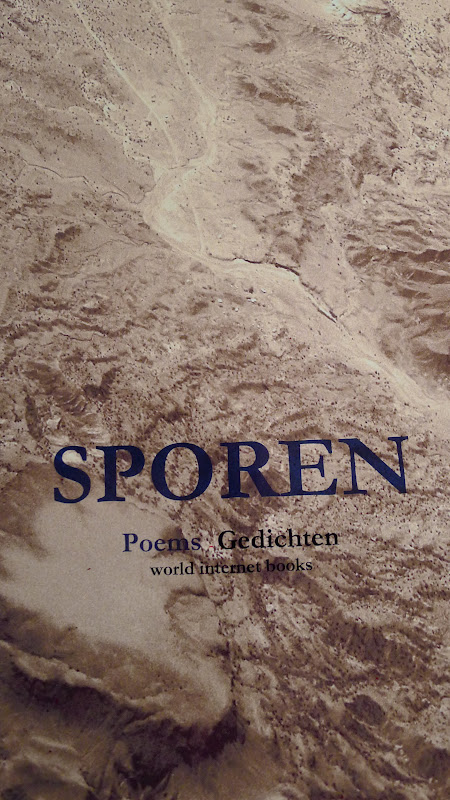
    Traces Sporen

     
    Traces as poetry, encounters, landscapes, sudden insights, as loss and loving again, as longing. In this book language explores fragmented places of belonging. 
    *
    Annmarie Sauer is a poetess of few words, limiting herself to the essence; what she writes is intense and felt deeply. Without frills and sure she paints with words. For her no parlando, and certainly no baroque. Nowhere does she make concessions to language. She is engaged and empathic and catches, seemingly effortless all movements and fluctuations of moods and confides them to paper in English and Dutch.
    Rose Vandewalle
     The presentation is March 23rd, 8PM: De Zwarte Panter, Hoogstraat 76, Antwerp, together with Roger Nupie and Annie Reniers 


    All is given
    by water & wind
    ice & fire
    now till in the greyest hour
    always all is in its place
    perfect unruliness
    battered
    predestined in
    the movement of time
    coincidence

    just as I
    *
    Alles is gegeven
    door water & wind
    ijs & vuur
    nu tot in het grijste uur
    altijd alles op zijn plaats
    volmaakte ongeregeldheid
    verweerd
    voorbeschikt in
    de beweging van de tijd           
    toeval

    net als ik

    Traces/Sporen, world internet books, publisher Fred Schywek

    Friday, March 2, 2012

    Lighthouse and Traces have arrived

    Two books for the presentation on March 23rd in De Zwarte Panter in Antwerp (8 PM) have arrived Roger Nupie's Lighthouse* Lichthaus was the first to come out of the crate. The title of the book refers to the novel of Virginia Woolf, just as the moving poem The waves. His poetry presented here is solemn, speaking of missing and longing. In the cycle  Her handwriting he remembers his grandmother kindly with the deep love of  grandson. Roger Nupie questions conventions in Self portrait, is playful and explicitly erotic in several poems, a.o. in Olivette. Yet he also challenges conventions in his self-portrait, no longer fulfilling the romantic image of a poet, but also in two poems about war and its consequences. The German translation is by Fred Schywek and the English by Annmarie Sauer. The translations are always proofread with the authors who authorize  them.


    To the lighthouse                                                Zum Leuchtturm

    De liefde                                                               Die Liebe
    verliest                                                                 verliert
    haar getijden.                                                      ihre Gezeiten.

    Dat wegebben blijft                                             Das Wegebben bleibt
    ons bij, versteend                                                uns erhalten, versteinert
    op de oever.                                                          auf dem Ufer.

    Nooit                                                                      Nie
    halen we                                                                holen wir
    morgen.                                                                 das Morgen.


    TO THE LIGHTHOUSE

    Love
    looses
    its tides.

    This ebbing away stays
    with us petrified
    on the shore.

    Never
    will we make it
    to tomorrow.

    Thursday, March 1, 2012

    Poetry as Insurgent Art

    Follows an extract from a message from Ms Irina Bokova, Director-General of UNESCO: On this World Poetry Day 2010, let us recall that poetry is a universal country in which peoples may meet through words of all colors, rhythms and musicality. Words that, regardless of the language from which they blossomed, reach out far for a light that captures the very essence of the human being, the dignity of each person. UNESCO, committed to its mandate to fully promote the democratic principles of dignity, equality and mutual respect perceives poetry as a vital resource.
    Yes poetry is alive and kicking but nit really thanks to Unesco, but thanks to the pets writing, reading, performing, small publisher spreading the words of poets, the translators who build bridges, further understanding. That is why from one day we organize a poetry festival starting March 17 in salon 12b with Job Degenaar and his book ICH BIN * I AM. Assisting poets will also have time to read and share their work. The activity o the actual poetry day is still being organized. Then the second event is on March 23 three poets, diverse in their way of writing will present each a book in Gallery The Black Panter in Antwerp: Annie Reniers with a trilingual book (Dutch, German and English): Letters of Light. Her reading is followed by Roger Nupie with  the also trilingual book. The last pet is Annmarie Sauer with a bi-lingual book Traces/Sporen. March 29 in the literary café den Hopsack in Antwerp it will be the Bart Stouten party with the trilingual book Open Heart. All books produced by poet Fred Schywek. April is poetry month in USA, so while being there we'll have a Desert Poetry Night with guest from San Francisco. We do all this to give a voice to more poets, to let people hear diverse forms of writing. Yet also because the Unesco system is rather cumbersome to work with as independent artists and to claim poetry as an insurgent art:

    Poetry as Insurgent Art  Lawrence Ferlinghetti
     
    I am signaling you through the flames.
    The North Pole is not where it used to be.
    Manifest Destiny is no longer manifest.
    Civilization self-destructs.
    Nemesis is knocking at the door.
    What are poets for, in such an age?
    What is the use of poetry?
    The state of the world calls out for poetry to save it.
    If you would be a poet, create works capable of answering the challenge of apocalyptic times, even if this meaning sounds apocalyptic.
    You are Whitman, you are Poe, you are Mark Twain, you are Emily Dickinson and Edna St. Vincent Millay, you are Neruda and Mayakovsky and Pasolini, you are an American or a non-American, you can conquer the conquerors with words....